Why Do Dogs Follow You to the Bathroom? Attachment and Routine Behavior
Written by MyCern Research & Editorial Team
If you have ever wondered why does my dog follow me to the bathroom, you are not alone. Many dog parents notice that their dog follows owner everywhere, including moments that feel very private and oddly specific.
The behavior is usually not about guarding you or being overly needy. In most cases, it reflects a mix of social attachment, predictable routines, and the way dogs naturally stay connected to their people.
This article explores:
- Why do dogs follow you to the bathroom from a behavioral and emotional perspective
- How routine and bonding shape this habit
- When following is healthy and when it may signal stress
- Simple, gentle ways to support independence at home
- How MyCern fits into everyday canine wellness routines
Why do dogs follow you to the bathroom in the first place?

The simplest explanation behind why do dogs follow you to the bathroom is social attachment.
Dogs evolved to live in close social groups. In a household, their primary social partner is often their owner. Following behavior allows dogs to stay close to the person who provides safety, interaction, and daily structure.
From a learning point of view, your dog quickly discovers that you move through the home many times each day. Walking with you becomes part of normal social flow rather than a special event.
This is why many owners describe their pet as a “shadow dog.”
In everyday life, dog follows owner to bathroom is simply one of the many short transitions your dog chooses to share with you.
Attachment and bonding with their human
Strong human animal bonds are well documented in canine behavior science. Dogs form attachment relationships that resemble secure social bonds rather than dependence.
Research organizations such as the American Kennel Club describe following behavior as a common expression of social connection, not a flaw in training.
When your dog chooses to stay near you, the behavior often reflects:
- trust in your presence
- comfort in shared space
- emotional security
In healthy relationships, dogs follow because they enjoy proximity, not because they panic when you leave.
Dog follows owner everywhere because of routine and predictability

Dogs rely heavily on patterns.
If you wake up, walk to the kitchen, go to the bathroom, and then prepare food or leave the house, your dog learns this sequence very quickly. Movement becomes a cue.
Over time, your dog begins to anticipate what comes next.
This makes why does my dog follow me to the bathroom partly a routine driven behavior. It is not about the room itself. It is about the predictable transition that happens before or after it.
Dogs feel safer when the daily structure is clear.
Curiosity and social connection
Bathrooms are also high traffic rooms with different sounds, smells, and movements. Curiosity plays a role.
Dogs are social observers. They monitor what their people are doing because shared activities help maintain social connection. Following you briefly allows your dog to remain part of the group interaction, even when no direct activity is happening.
This social monitoring is a normal part of canine communication.
Emotional comfort and mild separation sensitivity

In some households, why do dogs follow you in the bathroom becomes more noticeable during quieter moments or after changes in routine.
Following can provide emotional comfort when:
- the home schedule changes
- a family member is absent
- the dog has limited stimulation during the day
Veterinary behavior guidance, including material from the American Society for the Prevention of Cruelty to Animals, explains that mild clingy behaviors can appear when dogs seek reassurance during low level stress.
Importantly, this does not automatically mean clinical separation anxiety.
It often reflects temporary emotional adjustment.
When following becomes more intense or clingy
Healthy attachment looks relaxed and flexible.
You may want to look closer at the behavior if:
- your dog becomes distressed when doors close
- vocalizing or pacing starts when you move away
- the dog cannot settle without visual contact
In these situations, dog follows owner everywhere may move beyond normal bonding and begin to reflect emotional discomfort.
A qualified trainer or veterinarian can help distinguish between healthy social attachment and anxiety driven behaviors.
Is following you to the bathroom a problem?
In most cases, no.

For the majority of dogs, why does my dog follow me to the bathroom has a simple answer.
Your dog feels safe near you and enjoys being part of your routine.
The behavior becomes concerning only when:
- it escalates into distress
- independence disappears
- the dog cannot relax when alone
For calm, relaxed dogs, brief following is simply social companionship.
The role of boredom and daily stimulation
Low daily stimulation can increase attention seeking behaviors.
If your dog has limited play, training, or exploration opportunities, following you becomes an easy way to create engagement.
Dogs need:
- physical movement
- mental challenges
- social interaction
Without these outlets, staying near their owner becomes a substitute activity.
In some homes, why do dogs follow you to bathroom is partly explained by an understimulated daily schedule.
How to gently support healthy independence at home
You do not need to push your dog away or block access aggressively.

Gentle adjustments work better.
Try:
- adding short independent play sessions each day
- using food puzzle toys during quiet hours
- rewarding relaxed resting away from you
- maintaining predictable daily routines
These steps build confidence without removing your presence completely.
Encouraging independence is about offering meaningful alternatives, not separation.
Where MyCern fits into everyday canine wellness
At MyCern, we focus on supporting balanced daily routines, emotional stability, and healthy engagement in companion animals.
For dogs who follow their owners closely because of routine dependency or mild emotional reassurance seeking, MyCern’s canine wellness formulations are designed to complement daily lifestyle practices by supporting:
- calm behavioral balance
- stable daily rhythms
- positive engagement during rest and activity
Our products are not intended to treat behavioral disorders. Instead, they fit naturally into a broader lifestyle approach that prioritizes enrichment, predictable routines, and emotional comfort.
This wellness focused support aligns with practical strategies commonly recommended for dogs who display behaviors such as dog follows owner to bathroom and frequent shadowing.
Practical lifestyle tips for dogs that follow you everywhere
Small daily adjustments often make a noticeable difference.
- Schedule two short play or training sessions daily
- Rotate toys to maintain novelty
- Provide window views or safe outdoor observation time
- Use enrichment feeders during quiet periods
- Keep departure and arrival routines calm and predictable
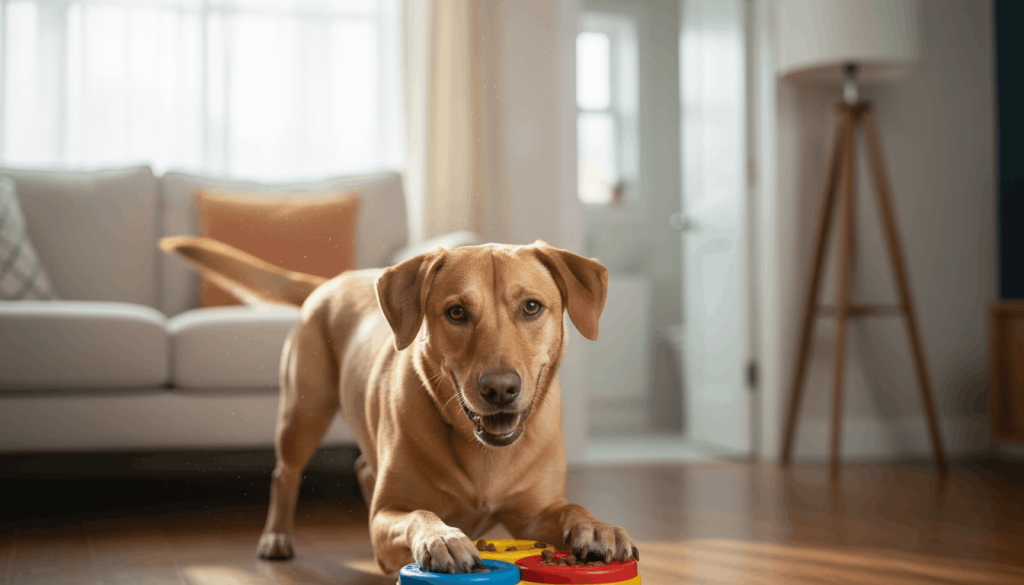
Many owners notice that once mental and physical needs are met consistently, following behaviors soften naturally.
Frequently asked questions
Why does my dog follow me to the bathroom but not other family members?
Dogs often form a primary social bond with one person. This usually reflects daily caregiving patterns and shared routines rather than favoritism.
Why do dogs follow you in the bathroom more when you are home all day?
Increased shared time strengthens routine associations. Your dog becomes more tuned to your movements and transitions.
Can following behavior increase with age?
Some dogs follow more as their confidence changes or mobility decreases. Staying close can provide reassurance when sensory abilities shift.
Should I stop my dog from following me?
If your dog is relaxed and able to settle independently at other times, there is no need to actively stop the behavior.
Conclusion
Understanding why do dogs follow you to the bathroom becomes much clearer when you view the behavior through the lens of attachment, routine, and social connection.
For most dogs, why does my dog follow me to the bathroom is not a sign of poor training or emotional weakness. It is a reflection of how deeply dogs integrate into human routines and relationships.

With predictable schedules, gentle independence building, and daily mental and physical engagement, dogs can maintain strong bonds while still developing confidence on their own. In a balanced home environment, following you into the bathroom remains what it usually is, a small, harmless expression of companionship.
References
- Horowitz, A. (2009). DOMESTIC DOGS (CANIS FAMILIARIS) USE VISUAL ATTENTION CUES WHEN PLAY SIGNALING: 16. Journal of Veterinary Behavior: Clinical Applications and Research, 4(2), 53-54.
- Topál, J., Miklósi, Á., Csányi, V., & Dóka, A. (1998). Attachment behavior in dogs (Canis familiaris): a new application of Ainsworth’s (1969) Strange Situation Test. Journal of comparative psychology, 112(3), 219.
- Mariti, C., Ricci, E., Carlone, B., Moore, J. L., Sighieri, C., & Gazzano, A. (2013). Dog attachment to man: A comparison between pet and working dogs. Journal of Veterinary Behavior, 8(3), 135-145.
- OOverall, K. (2013). Manual of clinical behavioral medicine for dogs and cats-E-Book: manual of clinical behavioral Medicine for dogs and cats-E-Book. Elsevier Health Sciences.verall, K. L. (2013). Manual of clinical behavioral medicine for dogs and cats. Elsevier.
- Bradshaw, J. W. S., McPherson, J. A., Casey, R. A., & Larter, I. S. (2002). Aetiology of separation‐related behaviour in domestic dogs. Veterinary Record, 151(2), 43-46.