

Understanding Food Labels for Pets: What Ingredient Order Really Tells You
Written by MyCern Research & Editorial Team
Pet food labels are designed to look reassuring clean fonts, wholesome imagery, and familiar ingredient names. Yet behind the packaging, the ingredient list is one of the most regulated and information-dense sections of the label. For pet owners, understanding what ingredient order truly represents can help clarify how a food is formulated and how it may support long-term health.
Ingredient lists are not marketing summaries. They are technical disclosures governed by weight, processing rules, and legal definitions. Learning how to interpret them correctly allows owners to move beyond assumptions and make more informed feeding decisions.
This article explores:
- How ingredient order is legally determined
- Why moisture content changes how ingredients appear
- What ingredient splitting means for formulation
- How to interpret protein, fat, and carbohydrate sources
- Why ingredient order matters but not in isolation
How Ingredient Order Is Determined

Pet food ingredients are listed by weight before processing, not by nutritional contribution after cooking. This distinction is critical.
Because fresh ingredients contain more water than dried ones, their placement can be misleading if moisture content is not considered.
For example:
- Fresh meat may appear first due to high water weight
- A dried protein meal may appear lower despite contributing more actual protein
Ingredient order reflects formulation weight, not nutrient density.
The Role of Moisture in Ingredient Placement
Fresh vs. Dry Ingredients
Fresh meats can contain up to 70–75% water. During cooking, much of this moisture is lost, reducing the ingredient’s final contribution.
In contrast:
- Meat meals are concentrated and dehydrated
- They contribute more protein per gram after processing
This means an ingredient listed second or third may still be a primary nutritional contributor.
Ingredient Splitting: Why Similar Items Appear Multiple Times
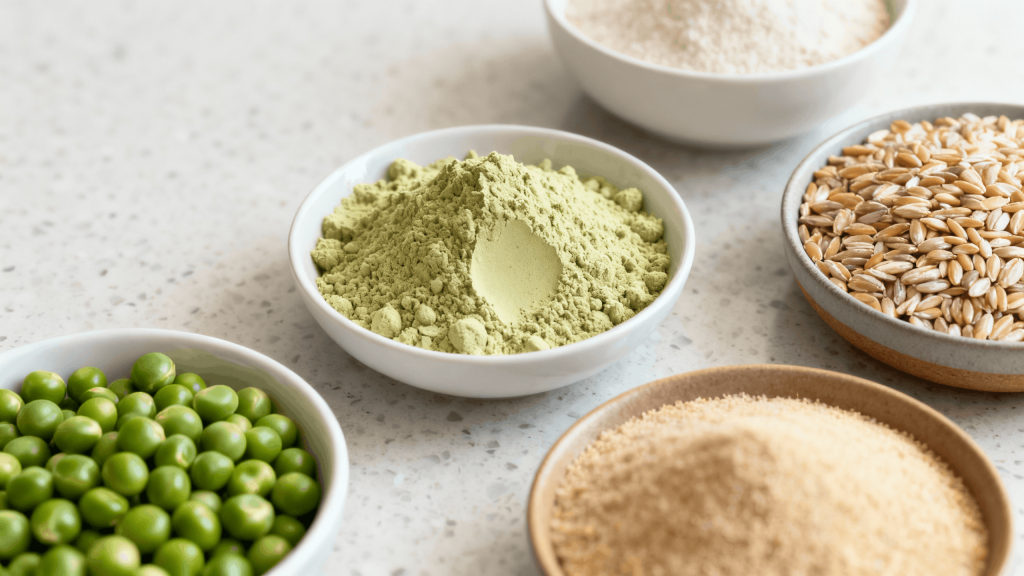
Ingredient splitting occurs when similar ingredients are listed separately to distribute their weight across the list.
Examples include:
- Corn flour, corn gluten meal, and ground corn
- Peas, pea protein, and pea fiber
When split, each component appears lower on the list, even though collectively they may represent a significant portion of the formula.
Understanding this practice helps prevent misinterpretation of ingredient prominence.
What Ingredient Order Does and Does Not Tell You
What It Tells You
- Relative weight contribution before processing
- The primary sources of raw materials
- Whether a formula emphasizes fresh, dried, or blended components
What It Does Not Tell You
- Digestibility of ingredients
- Amino acid balance
- Bioavailability of nutrients
- Quality of sourcing or processing
Ingredient order is a starting point, not a complete nutritional evaluation.
Interpreting Protein Sources on the Label

Protein sources may appear under various terms, each with regulatory definitions.
Common categories include:
- Fresh meat or poultry
- Meat or poultry meals
- By-products (which vary widely in quality and composition)
The presence of multiple protein sources can indicate formulation diversity, but quality depends on processing standards and digestibility, not naming alone.
Carbohydrates and Functional Ingredients
Carbohydrate ingredients often serve multiple roles beyond energy, including:
- Texture and structure
- Fiber content
- Digestive support
Whole grains, legumes, and root vegetables differ in starch type, fiber composition, and glycemic impact. Their position on the label should be viewed in the context of overall dietary balance, not isolated placement.
Additives, Micronutrients, and the “Less Than 1%” Rule

Ingredients listed after salt typically appear in very small amounts. These include:
- Vitamins and minerals
- Amino acids
- Preservatives and stabilizers
Their placement does not reflect importance, many are essential despite low inclusion rates.
Why Guaranteed Analysis Complements Ingredient Order
Ingredient lists describe what is used; guaranteed analysis explains how much of key nutrients are present.
Together, they provide a clearer picture of:
- Protein and fat levels
- Fiber and moisture content
- Overall macronutrient balance
Neither section should be interpreted independently.
Label Literacy as a Long-Term Skill
Understanding ingredient order empowers owners to:
- Compare foods more accurately
- Recognize formulation strategies
- Avoid assumptions driven by marketing language
Rather than searching for a “perfect” ingredient list, focusing on consistency, transparency, and nutritional adequacy supports better long-term feeding decisions.

Conclusion
Ingredient order on pet food labels offers valuable insight, but only when understood in its proper regulatory and nutritional context. Moisture content, ingredient splitting, and processing all influence how ingredients appear. By reading labels with a critical, informed perspective, pet owners can move beyond surface impressions and make choices grounded in nutritional understanding rather than marketing cues.
References
- Association of American Feed Control Officials (AAFCO). (2023). Official Publication: Ingredient Definitions and Feed Labeling. AAFCO Official Publication.
- Bauer, J., Heinemann, K., & Lees, G. (2010). Small animal clinical nutrition. Mark Morris Institute.
- CD, T. (2010). Small animal clinical nutrition: an iterative process. Small animal clinical nutrition, 3-21.
- National Research Council, Division on Earth, Life Studies, Committee on Animal Nutrition, Subcommittee on Dog, & Cat Nutrition. (2006). Nutrient requirements of dogs and cats. National Academies Press.
- Swanson, K. S., et al. (2013). Nutritional sustainability of pet foods. The Journal of Nutrition, 143(12), 2059–2063.

