
Feline Lower Urinary Tract Disease (FLUTD): Causes, Triggers, and Prevention
Written by MyCern Research & Editorial Team
Feline Lower Urinary Tract Disease (FLUTD) is not a single illness, but a collective term describing disorders that affect a cat’s bladder and urethra. What makes FLUTD particularly challenging is that many cases show no obvious infection, yet cause significant discomfort and recurring episodes. Stress sensitivity, mineral balance, and hydration patterns play a far greater role than many owners realize.
Because cats are biologically wired to conserve water and hide pain, urinary issues often escalate before clear signs appear. Understanding the mechanisms behind FLUTD helps shift prevention from reactive treatment to daily physiological support.
This article explores:
- What FLUTD actually is and how it differs from simple UTIs
- The role of stress and nervous system signaling
- How crystals form and why urine chemistry matters
- Why hydration patterns are central to prevention
- Practical, science-informed strategies to reduce recurrence
What Is FLUTD?
FLUTD refers to a group of conditions affecting the lower urinary tract, including the bladder and urethra. These conditions share similar outward signs such as straining to urinate or frequent litter box visits, but may arise from very different internal causes.
Common FLUTD categories include:
- Idiopathic cystitis (inflammation without infection)
- Urinary crystal or stone formation
- Urethattachate inflammation or spasm
- Obstruction, particularly in male cats
Importantly, most FLUTD cases are sterile, meaning bacteria are not the primary driver.
The Central Role of Stress in FLUTD
Stress is one of the most significant and underappreciated triggers of FLUTD. Cats have highly sensitive stress-response systems that directly influence bladder function.
Stress can alter:
- Bladder lining permeability
- Nerve signaling between the brain and bladder
- Inflammatory mediator release
Even routine changes such as new pets, rearranged furniture, schedule disruptions, or noisy environments, can activate these pathways. In stress-responsive cats, this neuro-inflammatory response can trigger bladder pain and dysfunction without any crystal presence.
Urinary Crystals: Not Just a Diet Issue
Urinary crystals form when minerals precipitate out of concentrated urine. The two most common types in cats are struvite and calcium oxalate crystals, each influenced by urine pH, mineral load, and concentration.
Key contributors include:
- Highly concentrated urine
- Imbalanced mineral intake
- Reduced voiding frequency
Crystals do not always cause symptoms on their own, but when combined with inflammation or stress-induced bladder sensitivity, they significantly increase FLUTD risk.
Hydration and Urine Concentration
Hydration is a cornerstone of FLUTD prevention because urine concentration directly affects both crystal formation and bladder irritation.
Cats evolved to obtain most of their water from prey, not bowls. As a result, many modern cats live in a state of chronic low-grade dehydration, producing smaller volumes of highly concentrated urine.
Concentrated urine:
- Increases crystal precipitation risk
- Intensifies bladder wall irritation
- Prolongs contact between irritants and bladder tissue
Supporting hydration reduces mechanical and chemical stress on the urinary tract.
Bladder Lining Integrity and Inflammation
A healthy bladder is protected by a glycosaminoglycan (GAG) layer that shields underlying tissue from urine constituents. In FLUTD-prone cats, this protective layer may become compromised.
When the barrier weakens:
- Urine solutes penetrate bladder tissue
- Nerve endings become hypersensitive
- Pain and inflammation persist even without infection
This explains why many cats experience recurrent episodes despite normal diagnostic tests.
Male Cats and Obstruction Risk
Male cats are at higher risk for life-threatening urethral obstruction due to their narrower urethras. Inflammation, crystals, or mucus plugs can quickly block urine flow.
Early signs of obstruction include frequent litter box visits with little output, vocalization, and agitation. Obstruction is a medical emergency requiring immediate veterinary care.
Long-Term Prevention Strategies
FLUTD management focuses on reducing triggers rather than treating isolated episodes. Effective prevention strategies address multiple physiological layers:
- Supporting consistent hydration patterns
- Reducing environmental and social stressors
- Encouraging frequent urination opportunities
- Maintaining appropriate urine chemistry
Stability and predictability are particularly important for stress-sensitive cats.
When Veterinary Evaluation Is Essential
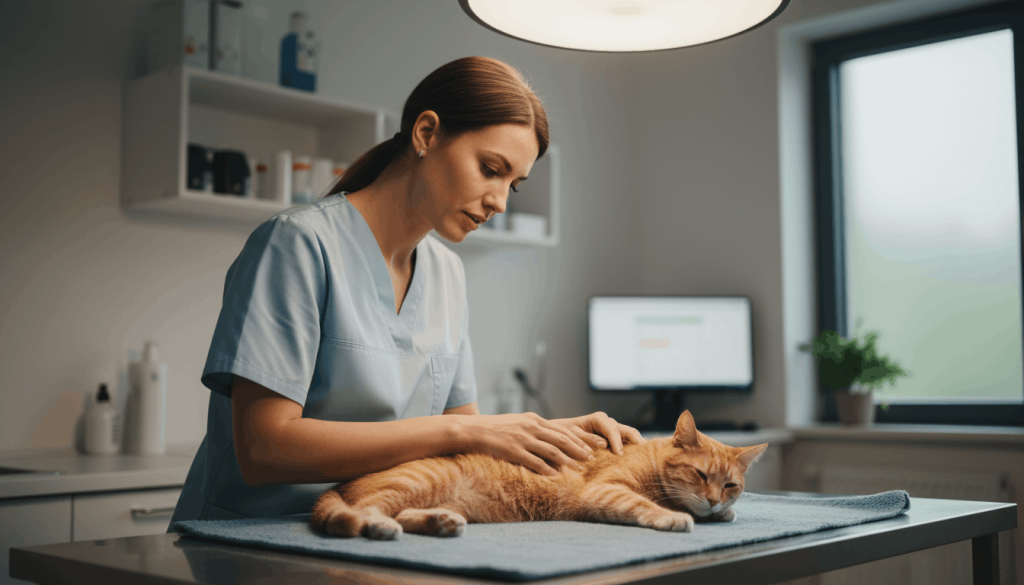
Any cat showing urinary straining, blood in urine, or sudden litter box avoidance should be evaluated promptly. Recurrent FLUTD cases benefit from ongoing monitoring to identify individual triggers and risk patterns.
Early intervention helps prevent complications such as obstruction and chronic bladder remodeling.
Conclusion
Feline Lower Urinary Tract Disease is a multifactorial condition shaped by stress physiology, urine chemistry, and hydration behavior, not simply diet or infection. Understanding these interconnected systems allows cat owners to move beyond symptom control toward meaningful prevention. By supporting the bladder’s environment and reducing physiological stressors, many cats can experience fewer episodes and greater long-term comfort.
References
- Forrester, S. D., & Towell, T. L. (2015). Feline idiopathic cystitis. Veterinary Clinics: Small Animal Practice, 45(4), 783-806.
- Westropp, J. L. (2005). Feline lower urinary tract disease. Textbook of veterinary internal medicine, 1828-1850.
- Osborne, C. A., Kruger, J. M., Lulich, J. P., Polzin, D. J., & Lekcharoensuk, C. (2000). Feline lower urinary tract diseases.
- Westropp, J. L., Kass, P. H., & Buffington, C. T. (2006). Evaluation of the effects of stress in cats with idiopathic cystitis. American journal of veterinary research, 67(4), 731-736.
- Buffington, C. T., Chew, D. J., Kendall, M. S., Scrivani, P. V., Thompson, S. B., Blaisdell, J. L., & Woodworth, B. E. (1997). Clinical evaluation of cats with nonobstructive urinary tract diseases. Journal of the American Veterinary Medical Association, 210(1), 46-50.

