
The Science of Canine Muscle Fiber Types and Endurance
Written by MyCern Research & Editorial Team
Why can one dog run tirelessly for miles while another excels in short bursts of speed? The answer lies deeper than training routines or daily activity levels. Canine endurance is largely determined by muscle fiber biology, the microscopic structure and metabolic behavior of muscle tissue that dictates how dogs generate, sustain, and recover energy.
Muscle fibers differ in how they use oxygen, fuel, and neural signals. These differences are strongly influenced by genetics, breed history, and physiology, and they shape a dog’s natural performance profile long before conditioning comes into play.
This article explores:
- The main muscle fiber types found in dogs
- How fiber composition affects endurance and fatigue
- The metabolic pathways that power sustained activity
- Why breed and genetics matter for performance capacity
- How aging and lifestyle influence muscle efficiency over time
What Are Muscle Fibers?
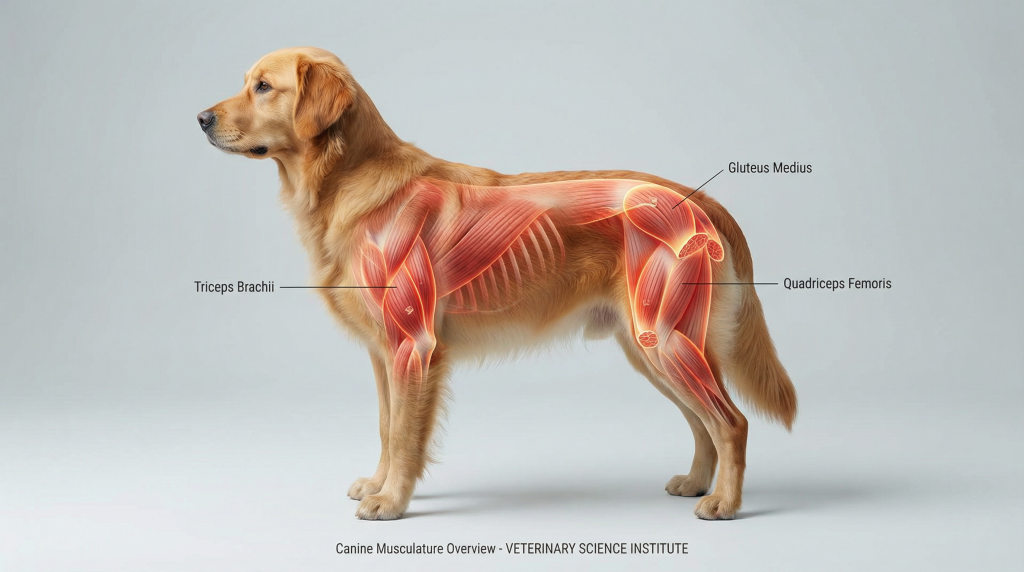
Skeletal muscle is composed of bundles of muscle fibers, each specialized for a particular type of work. These fibers contract in response to neural signals and differ in speed, strength, fuel use, and fatigue resistance.
In dogs, as in other mammals, muscle fibers are broadly classified into:
- Slow-twitch oxidative fibers
- Fast-twitch oxidative-glycolytic fibers
- Fast-twitch glycolytic fibers
The proportion and distribution of these fibers determine whether a dog is naturally built for endurance, power, or a combination of both.
Slow-Twitch (Type I) Fibers: The Endurance Engine

Slow-twitch fibers are optimized for aerobic metabolism, meaning they rely heavily on oxygen to produce energy.
Key characteristics include:
- High mitochondrial density
- Rich blood supply (capillarization)
- Efficient fat oxidation
- Slow contraction speed
- Strong resistance to fatigue
Dogs with a higher proportion of Type I fibers can sustain activity for long periods with relatively low energy cost. These fibers are central to endurance tasks such as long-distance running, herding, or steady tracking work.
Fast-Twitch Fibers: Speed and Power Specialists

Fast-twitch fibers contract rapidly and generate greater force, but they fatigue more quickly.
Fast Oxidative-Glycolytic (Type IIa) Fibers
These fibers represent a metabolic middle ground.
They:
- Use both oxygen and glucose for energy
- Support repeated bursts of activity
- Adapt well to conditioning
- Balance speed with moderate endurance
Type IIa fibers are crucial for dogs that alternate between sprinting and sustained movement.
Fast Glycolytic (Type IIb/IIx) Fibers
These fibers rely primarily on anaerobic glycolysis.
They:
- Produce high force quickly
- Depend heavily on stored glycogen
- Fatigue rapidly
- Generate more metabolic byproducts
Dogs with a higher proportion of these fibers excel in explosive movements but have limited endurance capacity.
Fiber Composition and Endurance Capacity
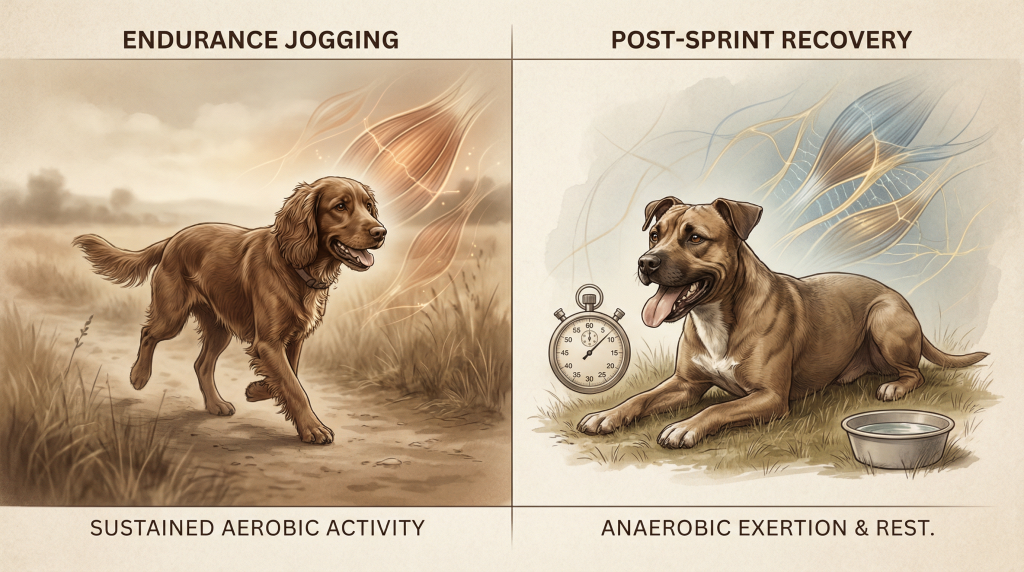
Endurance is not simply about muscle size or strength, it depends on how efficiently muscle fibers produce energy over time.
Dogs with greater oxidative fiber density:
- Maintain ATP production longer
- Accumulate fatigue-related metabolites more slowly
- Recover more efficiently between efforts
In contrast, dogs with predominantly glycolytic fibers may tire quickly even if they appear muscular and strong.
Genetics and Breed-Specific Muscle Profiles
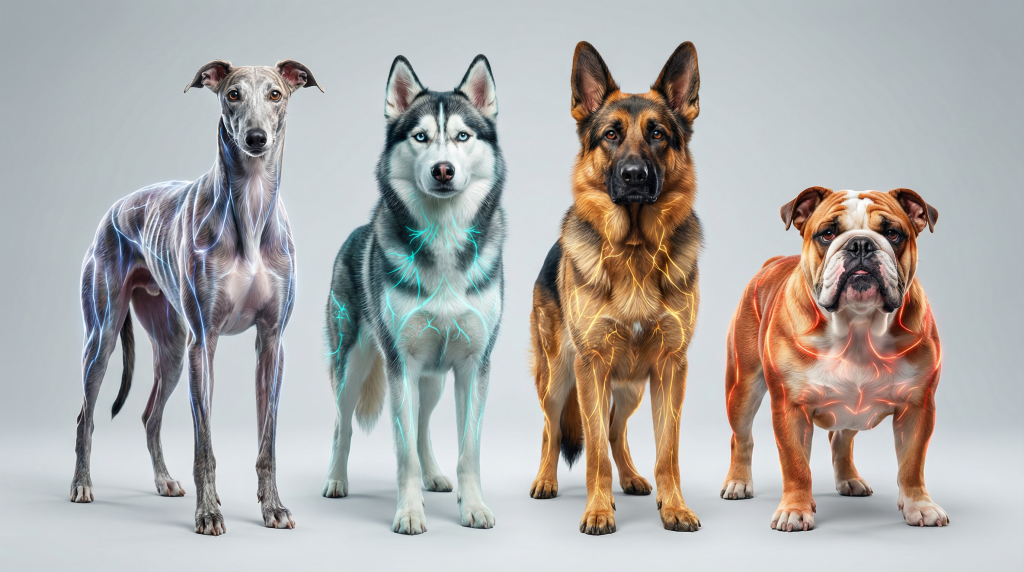
Selective breeding has shaped muscle fiber composition across breeds.
For example:
- Endurance-oriented breeds tend to have higher oxidative fiber proportions
- Sprint-oriented breeds show greater fast-twitch density
- Working dogs often exhibit mixed fiber profiles for versatility
These inherited traits influence performance ceilings and should inform expectations around stamina and workload tolerance.
Metabolic Pathways Behind Sustained Performance
Muscle endurance relies on coordinated metabolic systems, including:
- Mitochondrial oxidative phosphorylation
- Fatty acid transport and oxidation
- Efficient oxygen delivery via cardiovascular support
As activity continues, muscles gradually shift fuel sources, relying more on fat oxidation to preserve glycogen stores. Fibers with strong oxidative capacity manage this transition smoothly, delaying fatigue.
Aging and Muscle Fiber Function

With age, dogs experience gradual changes in muscle composition and efficiency.
Common trends include:
- Reduced mitochondrial density
- Slower oxidative metabolism
- Preferential loss of fast-twitch fibers
- Increased susceptibility to fatigue
These changes affect endurance even when overall muscle mass appears maintained.
Why Conditioning Has Limits
Training can improve mitochondrial density, capillary growth, and metabolic flexibility particularly in Type IIa fibers. However, fiber type distribution has a genetic ceiling.
This explains why conditioning improves performance but cannot fully override innate endurance or sprint predispositions.

Conclusion
Canine endurance is rooted in muscle fiber biology. The balance between slow- and fast-twitch fibers determines how dogs generate energy, resist fatigue, and recover from activity. Genetics, breed history, metabolism, and age all shape this internal landscape.
By understanding muscle fiber types, pet owners and professionals can better appreciate why dogs perform differently and why endurance is a matter of biology as much as behavior.
References
- Schiaffino, S., & Reggiani, C. (2011). Fiber types in mammalian skeletal muscles. Physiological Reviews, 91(4), 1447–1531.
- Rivero, J. L. L., et al. (1998). Muscle fiber type composition and endurance capacity. Journal of Applied Physiology, 85(2), 522–529.
- Bottinelli, R., & Reggiani, C. (2000). Human skeletal muscle fibres: Molecular and functional diversity. Progress in Biophysics and Molecular Biology, 73(2–4), 195–262.
- Lindholm, A., & Piehl, K. (1974). Fibre composition, enzyme activity, and endurance capacity in skeletal muscle. Acta Physiologica Scandinavica, 92(2), 145–156.
- McGowan, C. M., et al. (2002). Muscle fibre characteristics and performance in athletic mammals. Comparative Biochemistry and Physiology Part A, 131(4), 825–838.